
RFID Training Course. Learn online. Get Certified.
Take this easy but comprehensive online RFID Course (Radio Frequency Identification) Technology course) today. Get certified when you pass the associated exam.
- Self Paced Course, learn at your own speed, whenever you wish
- Access from any device PC/laptop/Mac/Tablet-no restrictions
- Prove your competency by displaying your electronic badge online on social media
- Full fledged e-learning course- Its not a video of a guy speaking or a pdf or a PPT

An easy learning software on Radio Frequency Identification Technology with free online exam & Certification.
Dear Friend,
You are here, reading this page, because you are well aware of the role of Radio Frequency Identification Technology in our everyday life. RFID technology is used by a wide range of organizations right from your local Wal Mart to the Department of Defense. The users of this new technology include supermarket chains (like Wal Mart), manufacturing industries of all types, logistics and shipping companies, hospitals, hotels and resorts, universities and many more. As a technical professional working in any of these industries, it is essential to understand how this new technology works and how it can benefit organizations by increasing productivity, reducing pilferage, increasing throughput and efficiency all around. However until now, there was no single resource that one could refer to, that explained this new technology in an easy to understand manner, without complicated math and physics, or partial differential equations (ugh!) or other such complex stuff.
The only choices a working technical professional like you had, were to surf the internet endlessly for information, or refer to expensive books that were complicated to read and understand, or enroll in an expensive classroom course. Each of these options has its advantages, but we say many disadvantages as well. For example you cannot spend hours of your valuable time surfing the net for information that may not be relevant or of of dubious accuracy. Books may be outdated or full of complicated math and physics, which unless you are designing some new identification technology itself, you really need not know.
Key Benefits of the Abhisam RFID Course
- Self Paced Course, learn at your own speed, whenever you wish
- Animations & Simulations to understand complex concepts
- Access from any device PC/laptop/Mac/Tablet-no restrictions
- Prove your competency by displaying your electronic badge online on social media
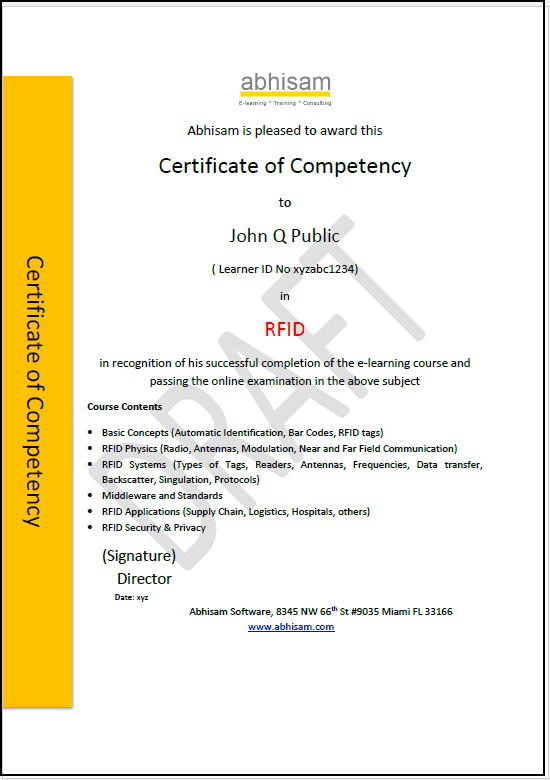
Get Certified as a RFID Professional! Earn an electronic badge that you can display online.

Feedback
“Thank you for allowing me to use the Abhisam RFID Course in my classroom. The students appreciate the timeliness and challenge of the cases relating to current supply chain issues. Discussion blossomed when the students discovered that the questions I asked regarding the cases currently have no “right” answers. The case studies enhanced their understanding of current challenges and opportunities with RFID technology in supply chain management”.
Ms. Carol Putman,
Penn State University, US
Learners from Marquee companies have taken this course




Understand concepts easily via animations. See how RFID technology is superior to bar codes.
Here is a sample question from the Self Assessment Test incl. in the course.

Real Life Applications
Learn how to implement RFID in real life applications such as
Tracking flow in the Pharmaceutical Supply Chain
Container tracking in a yard
Hospital patient identification & tracking
Airline baggage handling
Car parking access control
Car parking access with RFID
Hotels & Resorts
Choose from any of the versions.
Scroll below to see complete contents.
Standard
For one learner-
Course Duration: 8 hours of self paced learning (Earn 8 PDH)
-
Access the course online 24/7 via any device for one year
-
Exam & Certification for one learner
-
Lifelong Valid Certificate
Professional
For one learner-
Everything in Standard plus
-
Access course for 3 years
Get Trial Access to all Abhisam courses, including this RFID course for $7. You will NOT be billed automatically after trial ends.
Table of Contents.
Please click the + sign to expand and see details of every module.
Basic Concepts
Introduction to RFID
A modern history of RFID
An Attractive technology
Automatic Identification
Bar Codes
Matrix Bar Code
Use of Automatic Identification
What does a bar code reveal?
Do bar codes follow any standards?
What is a tag?
Active, Passive & Semi-Passive Tags
More RFID tags
What does an RFID reader read?
How is an RFID tag different from a bar code?
RFID systems
A shop using bar codes
A shop using RFID tags
Some Advantages of RFID over bar codes
Bar Code reader for a moving conveyor
RFID reader for a moving conveyor
Anti Counterfeiting
Advantages of RFID
Disadvantages of RFID
Summary of Basic Concepts
What are Waves?
Development of a wave
Parts of a wave
Electricity & Magnetism
A practical experiment
Amperes law & Biot Savart’s Law
Maxwell’s findings
Electromagnetic Waves
The Electromagnetic Spectrum
An electromagnetic wave
A transformer
A radio communication system
Antennas
Half wave dipole
Magnetic & Electric fields around antennas
Near field & Far field
What is Resonance?
A basic radio tuner
How does a Radio receiver work?
Modulation
Frequency Modulation
Digital Modulation
An example of Digital modulation
Amplitude Shift Keying
Frequency Shift Keying
Summary
RFID Tags
A Practical RFID system
Types of tags
Physical Construction
Smart label tags
Plastic encased tags
Tag Generations & Classes
RFID System Classifications
Tag Frequencies
Countries & Frequencies
Selection of Frequencies
RFID Readers
RFID Antennas
Doorway Antennas
Near Field & Far Field
Near Field Reader
Far Field Reader
Antenna Coverage Area
EAS Systems
EAS Reader-Working
Contactless Smart Cards
Near Field systems working
Data Transfer in NF systems
Load Modulation
Backscatter
Data transfer using backscatter
Collisions
Space,Frequency,Time domain anticollision
Singulation
Tree walking protocol
ALOHA
Slotted ALOHA
Summary
Middleware & Standards
What is Middleware?
Need for Middleware
Functions of Middleware
What is a Savant?
Middleware Architecture
EPCglobal
Electronic Product Code
What is EPCIS?
Object Naming Service
What is an EPC Tag?
How will the system work?
Standards in RFID
The Air Interface Protocol
Standards in RFID
Standards laid by ISO
Summary
Pharma Supply Chain
Container tracking in a yard
Hospital patient identification & tracking
Airline baggage handling
Car parking access control
Car parking access with RFID
Hotels & Resorts
Other applications
Summary
Security & Privacy fundamentals
Security Issues in RFID
Eavesdropping
Summary of Security Issues
Example of Privacy invasion
Privacy protection
Labeling the tag
RFID Reader Warnings
Use of a blocker tag
Blocker tag disadvantages
Killing Tags
Faraday Cage
Tracking with RFID
Summary
The RFID self assessment test enables you evaluate your own understanding of Radio Frequency ID tech, bar codes, auto-ID technology and other related topics. This also works like a mock test before you take the Abhisam RFID Certification exam.
Just get this RFID e-learning course today and for a much lesser price that you would be paying for any other course out there!
Note that it includes all the things that you must know regarding automatic identification technology including bar codes and RFID. No other course (Classroom or e-learning or software or online or video or any other) includes all of these in one package!
Can I not get this information free from elsewhere?
There is a myth “Just Google it”
Unfortunately it is not true. If you Google for it you are likely to get a large number of RFID related articles, videos, ebooks, blog posts, forum discussions and other stuff. You will spend a lot of your precious time to read it and after hours of doing this you may
a) Not be able to string it all together-most information on the internet is in chunks (although large ones). It is not put out there as a logical construct or in any sequential manner.
b) Be more confused than what you were before you started searching for it
c) You may not be sure that whatever information you get is current (updated) and authentic. Some people simply put out their opinion and call it as fact
d) Nobody will give you a certificate for your internet research.
You will spend several days doing all this for zero returns on your investment!
But, when you take this Abhisam RFID Training course, you know that
a) It is very carefully made, with inputs from subject matter experts in the field of Automatic Identification, Wireless technology and RFID.
b) Utilizes animations and simulations to help you understand concepts real quick. These are not available anywhere else.
c)) Earn a Certificate when you pass the associated exam and also get an electronic badge that can be displayed online on places such as LinkedIn. Get Noticed as knowledgeable RFID professional!
Can I not simply buy a book? That will be much cheaper!
Of course, you could always decide to go for buy a book on this topic,
but,
remember that there are some disadvantages with this approach
a) There is no single book that covers all the topics that you need to know regarding RFID, Automatic Identification and Wireless physics. On the other hand, there are a lot of things in every book, that you can safely skip, without missing anything.
b) Some of these books may be outdated
c) Learning from an animated simulation makes you grasp a concept much faster than merely reading about it.
d) Nobody gives you a certificate if you simply read a book.
Frequently brought together

Take this Industrial Cybersecurity course today and learn everything that you need to know to protect your plant assets and your Industrial Control & Automation system (DCS/PLC/SCADA), Safety Instrumented System (SIS) or Building Automation System (BMS) or any other automation system from cyber attacks.

The only e-learning Fieldbus course that covers FOUNDATION Fieldbus (FF), HART, Profibus PA and ASi bus in one single course.
Learn from animations and simulations, real life examples and a full case study of a Fieldbus project.
Questions?
Contact Us by filling the form below OR call us OR email
